
##
Automation for electricians does not need to mean complicated software, coding or spending hours building systems yourself.
In practical terms, automation simply means getting software to carry out repetitive tasks automatically based on rules you choose.
For an electrical business, that could mean moving jobs into the correct queue, adding the right forms, applying badges, updating notes or making sure important information appears at the right point in the job.
What Does Automation for Electricians Actually Mean?
Business automation is the process of creating rules that trigger actions without someone manually completing each step.
For example, an electrician might normally finish a job, open ServiceM8, update the job status, move the job to another queue and check that the correct paperwork has been completed.
Automation can handle some of those steps automatically.
That matters because most electrical businesses do not struggle because the owner cannot do the electrical work. They struggle because one person is trying to quote jobs, answer customers, organise the diary, complete paperwork, manage engineers and keep track of what still needs doing.
Small repetitive tasks quickly become hours of admin every week.
How ServiceM8 Automation Can Help Electricians
ServiceM8 already holds a large amount of information about each job. That information can be used to decide what happens next.
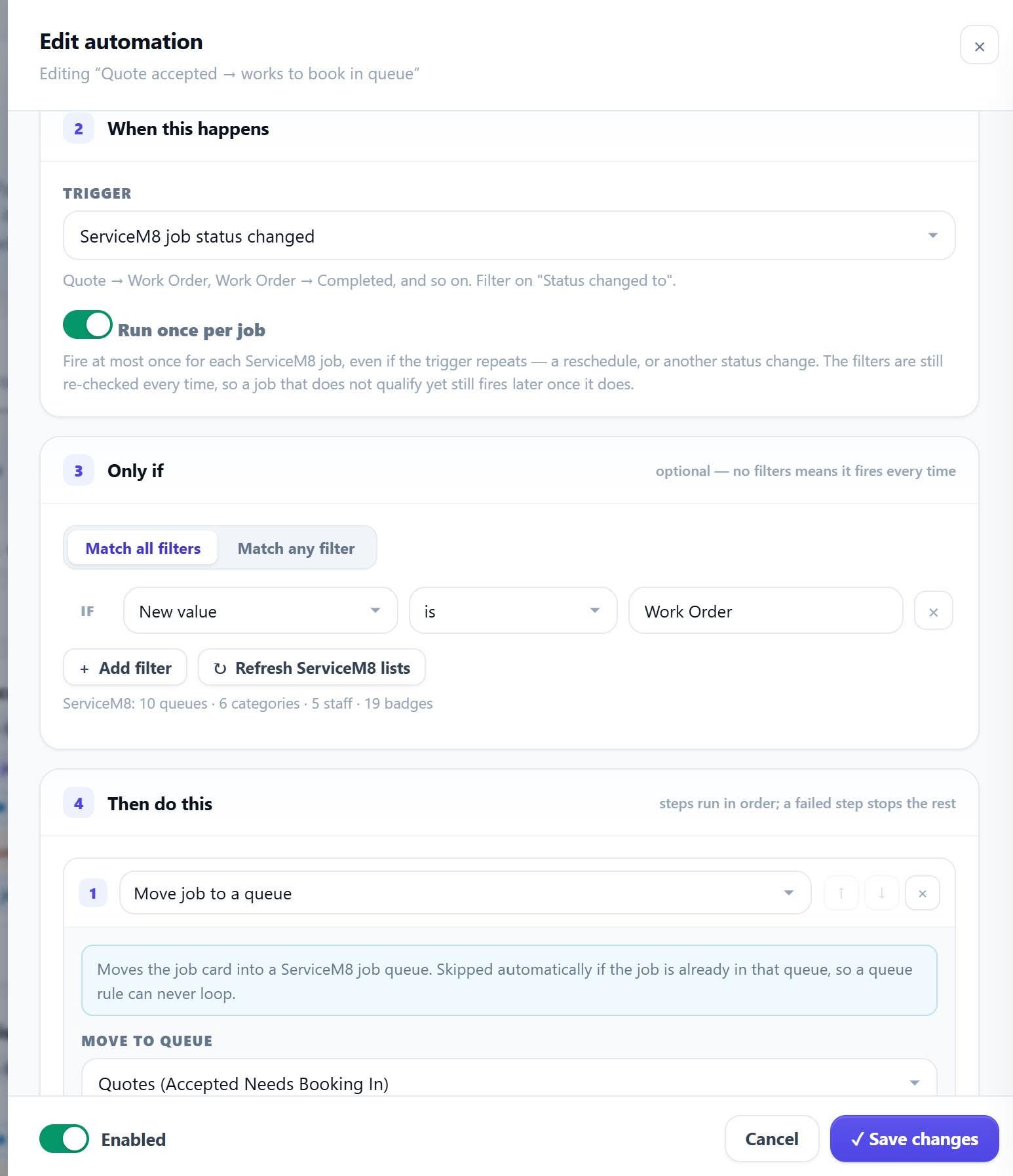
Automatically move jobs between queues
Jobs can move between queues based on information such as:
- Job status
- Job category
- Assigned badges
- Specific job information
- Stages in your workflow
For example, you could create a system where a job that changes from a quote to a work order gets moved to a queue prompting an admin assistant to schedule the work. ( I literally did this earlier for someon)
This means you do not have to rely on someone remembering what happens next.
Add forms to the right jobs
Forms are useful for keeping work consistent, especially when several engineers work in the business.
Different jobs may require different paperwork.
A consumer unit change might need one set of checks, while an EICR, fault finding visit or EV charger installation may require something completely different.
Automation can help make sure the relevant forms appear on the correct jobs instead of relying on an electrician to find and add them manually.
Add badges automatically
Badges can make jobs easier to identify at a glance.
You might use badges for:
- Certificates required
- Deposit paid
- Materials needed
- Quote follow-up
- Return visit required
- High-priority customer
- Specific types of installation
Automatically applying badges means important information becomes visible without somebody having to remember to update every job manually.
Add notes and instructions
Automation can also add notes to jobs based on particular conditions.
For example, a specific job category could trigger a note reminding the electrician to take certain photographs, complete a form or check a particular item before leaving site.
That gives engineers useful information at the point they need it.
Why Automation Reduces Human Error
Most admin mistakes do not happen because someone is careless. They happen because people are busy.
You finish a long day, get back in the van and have six different things to remember.
You need to send a quote, chase a customer, upload photographs, complete paperwork and remember that one job needs a return visit.
Something gets missed.
A good automation system removes some of that dependence on memory.
If a task follows the same rule every time, software can usually handle at least part of it.
That creates consistency.
Instead of hoping everyone follows the process, the process becomes part of the system.
You Do Not Need to Become a Software Expert
One of the biggest misconceptions around automation for electricians is that you need to understand the technical side.
You do not.
The most useful starting point is understanding how you want your business to work.
You should be able to explain things in plain English, such as:
“When this type of job gets completed, I want it moved here, this badge added and this form checked.”
Someone who understands automation can then build the workflow around that requirement.
You do not need to understand every trigger, integration or technical setting behind it.
You need to understand the result you want.
Start With the Tasks You Repeat Most
Trying to automate an entire electrical business at once usually creates unnecessary complexity.
Start with repetitive tasks.
Look at what you do every day or every week and identify jobs that follow a predictable pattern.
Good examples include:
- Moving completed jobs into the next workflow stage.
- Adding forms to particular job categories.
- Applying badges based on job type.
- Adding standard notes or engineer instructions.
- Flagging jobs that still require paperwork.
- Organising jobs that are ready for invoicing.
These small automations can remove dozens of manual actions from your working week.
Common Automation Mistakes Electricians Make
The biggest mistake is automating a bad process.
If your existing workflow is confusing, adding automation can make the confusion happen faster.
Map out what should happen first.
Another mistake is making the system too complicated. Ten useful automations that your team understands will usually work better than fifty complicated ones nobody trusts.
You should also review automations occasionally. Electrical businesses change. Staff change, services change and the way you manage jobs changes.
Your systems should change with them.
Automation Should Give You More Time for Valuable Work
The purpose of automation is not to remove people from an electrical business.
It is to stop skilled people wasting time on repetitive admin.
If you are an electrician, your time is usually better spent quoting profitable work, completing jobs, speaking to customers, managing your team or improving the business.
Moving job cards between queues should not need your attention every time.
That is where automation becomes valuable.
A well-built system quietly handles the predictable parts of the business while you focus on the work that requires judgement, experience and human input.
FAQ: Automation for Electricians
What is automation for electricians?
Automation for electricians uses software to complete repetitive business tasks automatically. This can include organising jobs, adding forms, applying badges, updating workflows and reducing manual admin.
Can ServiceM8 be automated?
Yes. ServiceM8 workflows can use job information such as status, category and badges to help trigger different actions and organise jobs more efficiently.
Do I need technical knowledge to automate my electrical business?
No. You mainly need to understand what you want the business process to do. An automation specialist can handle the technical setup.
What should an electrician automate first?
Start with repetitive tasks that follow clear rules. Job organisation, forms, badges, paperwork checks and invoicing workflows are useful places to begin.
Will automation replace office staff or electricians?
Automation works best when it removes repetitive manual tasks. It allows electricians and office staff to spend more time on work that needs judgement, customer communication and technical expertise.
Is automation only useful for large electrical companies?
No. Sole traders and small electrical businesses can benefit because they often have fewer people available to handle administration. Even a few simple automations can make the business easier to manage.